For State Employees
Understanding the Shutdown
A government shutdown occurs when Congress fails to pass annual appropriations bills or temporary funding resolutions to keep federal agencies operating. When this happens, the federal government legally loses its authority to spend money, forcing a suspension of all non-essential operations.
Although shutdowns are often seen as political events, their effects ripple across every level of government — federal, state, and local — affecting public employees, contractors, and essential services.
Impact on State Employees: Who Gets Paid and When
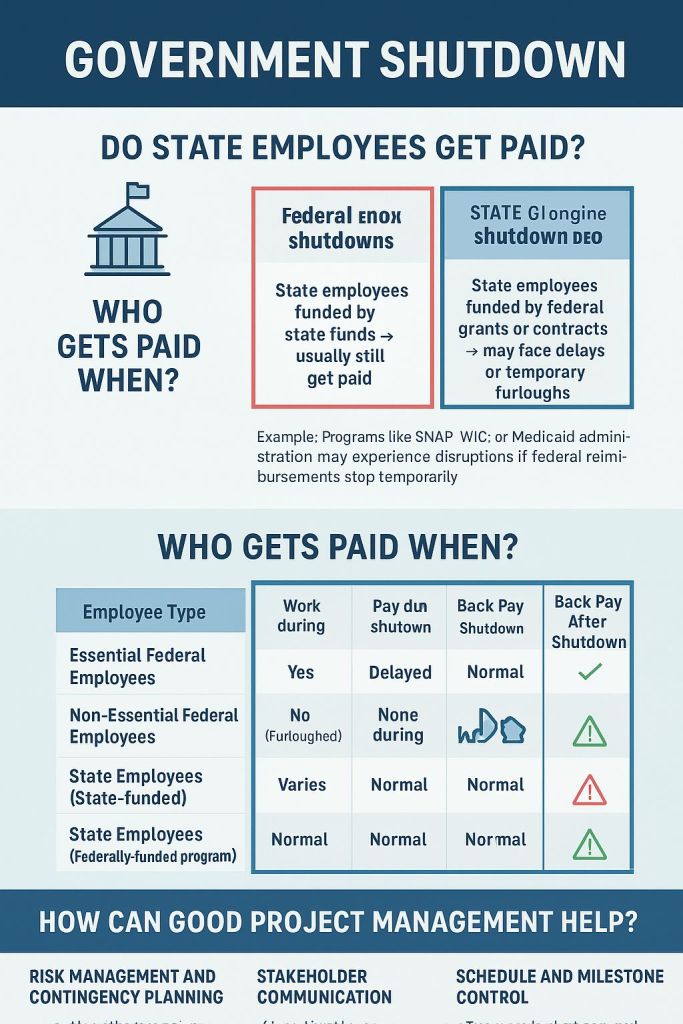
The impact of a federal shutdown on state employees depends largely on how their positions are funded.
- State-Funded Employees:
Those whose salaries come solely from state resources typically continue to work and receive regular paychecks, since state budgets operate independently of federal appropriations. - Federally-Funded or Shared-Funded Employees:
Many state programs, such as Medicaid, SNAP, or certain transportation and education initiatives, rely on federal grants. When those funds are interrupted, states may temporarily furlough employees or delay payments until federal funding resumes. - Essential Employees:
Both federal and state governments maintain essential operations — including public safety, healthcare, and emergency response. Essential employees are required to work even during shutdowns, though their pay may be delayed until after government funding is restored.
Why Shutdowns Happen
While frustrating and disruptive, shutdowns occur due to the Antideficiency Act, a law that prohibits government agencies from spending money not authorized by Congress. Without approved funding, agencies must halt non-essential services to comply with the law.
Shutdowns are often triggered by:
- Political disagreements over spending priorities or policy provisions.
- Delays in passing appropriations bills or continuing resolutions.
- Policy riders that attach controversial measures to essential funding bills.
Although intended as a safeguard for fiscal discipline, shutdowns can cause extensive disruptions, halting programs, delaying payments, and undermining public trust.
How Project Management Can Prevent or Mitigate Shutdown Impacts
Effective project management provides tools and structures that can reduce the frequency, duration, and severity of shutdowns. When applied to budget processes and interagency coordination, project management disciplines can turn chaos into continuity.
1. Risk Management & Contingency Planning
Proactive identification of high-risk areas—such as programs dependent on federal funds—helps agencies create contingency plans. Maintaining reserve funds or alternate agreements ensures continuity of essential operations.
2. Stakeholder Communication
A strong communication plan keeps policymakers, employees, and the public informed. Regular updates and scenario planning reduce confusion and panic during potential shutdowns.
3. Schedule and Milestone Control
Treating the budget approval cycle as a project—with clear deadlines, responsibilities, and dependencies—enables better tracking and early detection of delays. Tools like Gantt charts or Agile sprints can ensure progress visibility.
4. Change and Issue Management
Structured decision-making frameworks allow political and administrative teams to handle policy disputes earlier, preventing them from stalling the entire funding process.
5. Process Improvement and Lean Thinking
Applying Lean Six Sigma and continuous improvement principles to the budgeting process helps eliminate redundancy, streamline reviews, and shorten the time between proposal and approval.
The Bigger Picture
Shutdowns are not merely political stand-offs—they are project and process failures that cost taxpayers billions and strain public trust. While laws like the Antideficiency Act enforce accountability, it is disciplined project management, communication, and foresight that can prevent these crises.
By managing the budget process like a complex, multi-stakeholder project—with defined risks, milestones, and contingency strategies—government leaders can create a more resilient public sector that continues to serve citizens even amid political uncertainty.
Conclusion
A government shutdown may be a legal necessity under certain circumstances, but it should never be a recurring feature of governance. The key to avoiding such costly disruptions lies in strong project management practices, proactive risk planning, and a commitment to operational transparency.
When government acts with the same discipline and foresight it expects from private-sector projects, it can ensure that essential services never stop — no matter what happens in the political arena.
 Solution Minded GovTech Project Manager
Leave a comment